Research Group Dr. Michael Tyler
Mapping cancer progression with data integration approaches
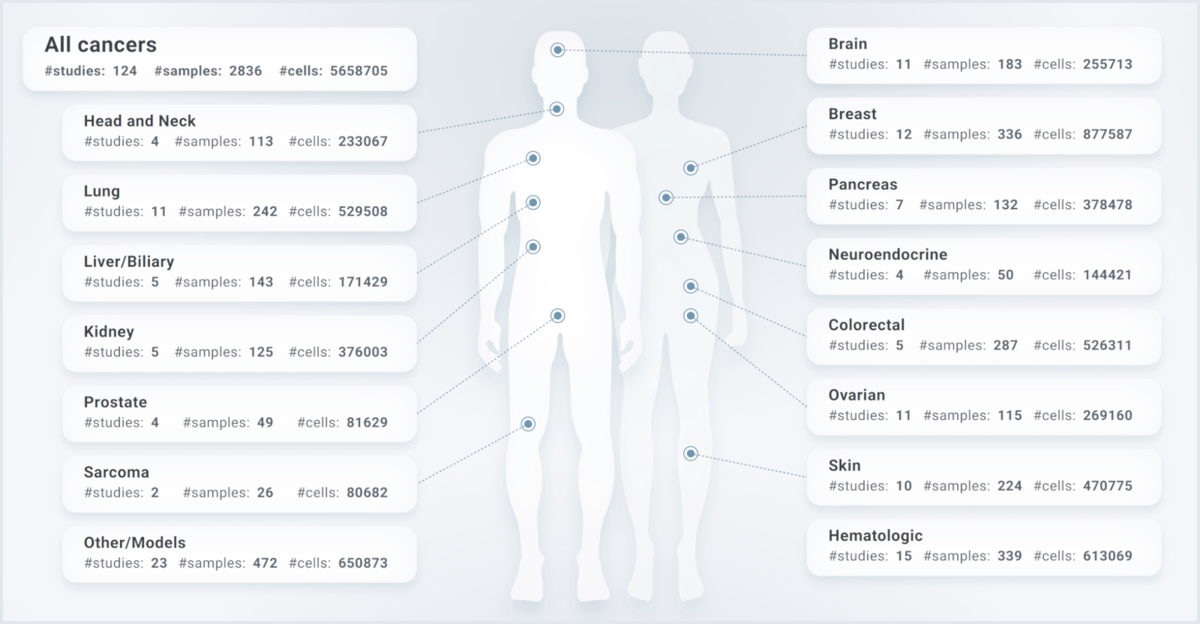

Cellular heterogeneity is a major barrier to cancer treatment. Variability in tumour cell states and microenvironmental composition between patients leads to differing treatment responses, while variability within a single tumour may indicate the presence of cell subpopulations able to survive therapy and drive continued disease progression. Single-cell RNA-seq (scRNA-seq) has proven to be highly effective at deciphering this heterogeneity, providing the resolution needed to isolate individual cell types and expression states.
However, due to cost and various technical considerations, individual scRNA-seq studies profile relatively few tumours (typically around 5 to 20) and usually lack comprehensive clinical annotations. Moreover, scRNA-seq profiles represent only a snapshot within a long timeline of tumour development. These challenges severely hinder the power of individual scRNA-seq datasets to identify the cellular states most relevant to cancer progression. Integration of many datasets of different disease stages is a highly promising way to overcome this.
The goal of my lab is to elucidate the epigenetic and microenvironmental changes that define the progression of cancer along its full timeline, from the earliest stages of malignant transformation all the way to recurrent and metastatic disease. This will be achieved by integrating data across many patients, cancer types and disease stages, in order to recover changes that are (i) robustly detectable across patients, thus likely to reflect true biology and not technical effects; (ii) conserved across multiple cancer types, suggesting common therapeutic vulnerabilities; and (iii) predictive of disease progression and suggestive of new treatment opportunities.
An integrative, pan-cancer approach was recently used to characterise recurrent expression programs across a collection of over 120 scRNA-seq datasets and over 2000 patient tumours, a database called the Curated Cancer Cell Atlas, or 3CA (Nature 2023, 3CA). My lab will extend this effort to timepoints along the full cancer development continuum, integrating 3CA with published datasets for normal tissue, premalignant disease and advanced cancer stages. We will further deepen this analysis by incorporating spatial transcriptomics and imaging data, in order to fully capture microenvironmental relationships. With these multimodal comparisons, we will uncover general principles of cancer development and reveal new therapeutic windows for improved cancer treatment.


The Curated Cancer Cell Atlas provides a comprehensive characterization of tumors at single-cell resolution.
Tyler M, Gavish A, Barbolin C, Tschernichovsky R, Hoefflin R, Mints M, Puram SV, Tirosh I.
Nat Cancer. 2025 Jun;6(6):1088-1101.
Hallmarks of transcriptional intratumour heterogeneity across a thousand tumours.
Gavish A, Tyler M, Greenwald AC, Hoefflin R, Simkin D, Tschernichovsky R, Galili Darnell N, Somech E, Barbolin C, Antman T, Kovarsky D, Barrett T, Gonzalez Castro LN, Halder D, Chanoch-Myers R, Laffy J, Mints M, Wider A, Tal R, Spitzer A, Hara T, Raitses-Gurevich M, Stossel C, Golan T, Tirosh A, Suvà ML, Puram SV, Tirosh I.
Nature. 2023 Jun;618(7965):598-606
Decoupling epithelial-mesenchymal transitions from stromal profiles by integrative expression analysis.
Tyler M, Tirosh I.
Nat Commun. 2021 May 10;12(1):2592.
More publications
Subtypes and proliferation patterns of small intestine neuroendocrine tumors revealed by single-cell RNA sequencing
Elife. 2025 Jul 23;13:RP101153. doi: 10.7554/eLife.101153.
ABSTRACT
Neuroendocrine tumors (NETs) occur primarily in the small intestine, lung, and pancreas. Due to their…
The Curated Cancer Cell Atlas provides a comprehensive characterization of tumors at single-cell resolution
Nat Cancer. 2025 Jun;6(6):1088-1101. doi: 10.1038/s43018-025-00957-8. Epub 2025 May 8.
ABSTRACT
Recent years have seen a rapid proliferation of single-cell cancer…
Hallmarks of transcriptional intratumour heterogeneity across a thousand tumours
Nature. 2023 Jun;618(7965):598-606. doi: 10.1038/s41586-023-06130-4. Epub 2023 May 31.
ABSTRACT
Each tumour contains diverse cellular states that underlie intratumour…
Genome-wide CRISPR screen identifies PRC2 and KMT2D-COMPASS as regulators of distinct EMT trajectories that contribute differentially to metastasis
Nat Cell Biol. 2022 Apr;24(4):554-564. doi: 10.1038/s41556-022-00877-0. Epub 2022 Apr 11.
ABSTRACT
Epithelial-mesenchymal transition (EMT) programs operate within…
Decoupling epithelial-mesenchymal transitions from stromal profiles by integrative expression analysis
Nat Commun. 2021 May 10;12(1):2592. doi: 10.1038/s41467-021-22800-1.
ABSTRACT
Epithelial-to-mesenchymal transition (EMT) is the most commonly cited mechanism for cancer…