Research Group Dr. Mélanie Tichet
Immunoregulatory mechanisms in the tumor microenvironment and resistance to therapy

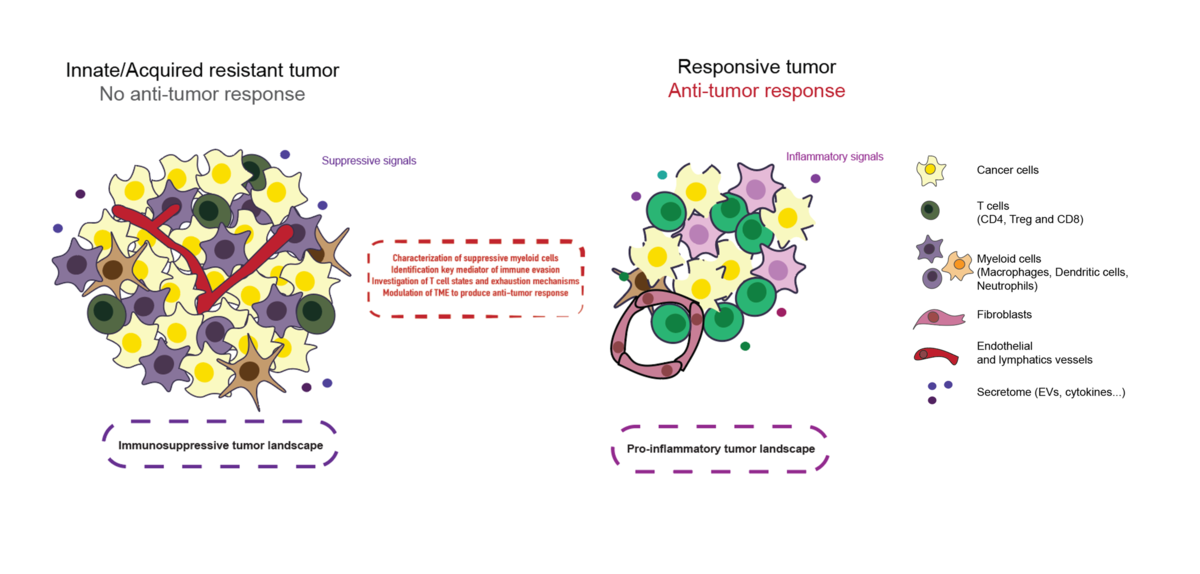
Breakthroughs in cancer treatment have come from understanding oncogenic signaling, the tumor ecosystem, and cancer immunobiology. Targeted therapies provide – in some tumor types – remarkably high clinical responses followed, unfortunately, by relapse. In contrast, immunotherapies, especially checkpoint inhibitors, can induce long-lasting responses by activating anti-tumor immunity, albeit only in a subset of patients. These limitations have driven interest in understanding both innate and acquired resistance to therapies.
Our research focuses on unraveling the complexity of the interplay between cancer and stromal cells in the tumor microenvironment (TME), as tumors erect multiple barriers to evade immune destruction, resulting in non-responsiveness to treatments. Therefore, we are delving into the roles and regulation of suppressive cell populations to identify vulnerabilities in cancer and stromal cell crosstalk that can be targeted therapeutically. To better understand the microenvironment-mediated mechanisms of therapeutic resistance and recurrence in malignancies, we will investigate acquired and innate resistances associated with alterations in the activation of suppressive populations (i.e., tumor-associated macrophages) and their effectors to suppress tumor immunity in response to therapies.
Taking advantage of our immunocompetent GEMM models of cancer (melanoma, pancreatic cancer, and glioma) and our collaboration with our clinical partners, we aim to
- investigate susceptibility and resistance to immunotherapies (innate and acquired),
- elucidate cancer immunosuppressive barriers and the means to transform them into components that elicit tumor immunity,
and - dissect T cell activity and dysfunction.


Tichet, M., Wullschleger, S., Chryplewicz, A., Fournier, N., Marcone, R., Kauzlaric, A., Homicsko, K., Deak, L.C., Umaña, P., Klein, C., et al. (2023).
Bispecific PD1-IL2v and anti-PD-L1 break tumor immunity resistance by enhancing stem-like tumor-reactive CD8+ T cells and reprogramming macrophages.
Immunity 56, 162-179.e6. 10.1016/j.immuni.2022.12.006.
• Highlighted by: Immunity, Jan 2023 : 10.1016/j.immuni.2022.12.012
Zeng, Q., Saghafinia, S., Chryplewicz, A., Fournier, N., Christe, L., Xie, Y.-Q., Guillot, J., Yucel, S., Li, P., Galván, J.A., (…), Tichet, M., Homicsko, K., Hanahan, D. (2022).
Aberrant hyperexpression of the RNA binding protein FMRP in tumors mediates immune evasion.
Science 378, eabl7207.10.1126/science.abl7207.
Chryplewicz, A., Scotton, J., Tichet, M., Zomer, A., Shchors, K., Joyce, J.A., Homicsko, K., and Hanahan, D. (2022).
Cancer cell autophagy, reprogrammed macrophages, and remodeled vasculature in glioblastoma triggers tumor immunity.
Cancer Cell 40, 1111-1127.e9.10.1016/j.ccell.2022.08.014.
Codarri Deak, L., Nicolini, V., Hashimoto, M., Karagianni, M., Schwalie, P.C., Lauener, L., Varypataki, E.M., Richard, M., Bommer, E., Sam, J., (…),Tichet, M., Hanahan D., (...), et al. (2022).
PD-1-cis IL-2R agonism yields better effectors from stem-like CD8+ T cells.
Nature 610, 161–172.10.1038/s41586-022-05192-0.
More Publications
A new effLuc/Kate dual reporter allele for tumor imaging in mice
Dis Model Mech. 2025 Jan 1;18(1):DMM052130. doi: 10.1242/dmm.052130. Epub 2025 Jan 31.
ABSTRACT
Genetically engineered mouse models (GEMMs) are instrumental for…
Bispecific PD1-IL2v and anti-PD-L1 break tumor immunity resistance by enhancing stem-like tumor-reactive CD8+ T cells and reprogramming macrophages
Immunity. 2023 Jan 10;56(1):162-179.e6. doi: 10.1016/j.immuni.2022.12.006.
ABSTRACT
Immunotherapies have shown remarkable, albeit tumor-selective, therapeutic benefits…
Aberrant hyperexpression of the RNA binding protein FMRP in tumors mediates immune evasion
Science. 2022 Nov 18;378(6621):eabl7207. doi: 10.1126/science.abl7207. Epub 2022 Nov 18.
ABSTRACT
Many human cancers manifest the capability to circumvent attack by the…
PD-1-cis IL-2R agonism yields better effectors from stem-like CD8+ T cells
Nature. 2022 Oct;610(7930):161-172. doi: 10.1038/s41586-022-05192-0. Epub 2022 Sep 28.
ABSTRACT
Expansion and differentiation of antigen-experienced PD-1+TCF-1+…
Cancer cell autophagy, reprogrammed macrophages, and remodeled vasculature in glioblastoma triggers tumor immunity
Cancer Cell. 2022 Oct 10;40(10):1111-1127.e9. doi: 10.1016/j.ccell.2022.08.014. Epub 2022 Sep 15.
ABSTRACT
Glioblastoma (GBM) is poorly responsive to therapy and…
Myeloid Cells Orchestrate Systemic Immunosuppression, Impairing the Efficacy of Immunotherapy against HPV+ Cancers
Cancer Immunol Res. 2020 Jan;8(1):131-145. doi: 10.1158/2326-6066.CIR-19-0315. Epub 2019 Nov 26.
ABSTRACT
Cancers induced by human papillomaviruses (HPV) should be…
ALK7 Signaling Manifests a Homeostatic Tissue Barrier That Is Abrogated during Tumorigenesis and Metastasis
Dev Cell. 2019 May 6;49(3):409-424.e6. doi: 10.1016/j.devcel.2019.04.015.
ABSTRACT
Herein, we report that the TGFß superfamily receptor ALK7 is a suppressor of…
Nanoparticle Conjugation of Human Papillomavirus 16 E7-long Peptides Enhances Therapeutic Vaccine Efficacy against Solid Tumors in Mice
Cancer Immunol Res. 2018 Nov;6(11):1301-1313. doi: 10.1158/2326-6066.CIR-18-0166. Epub 2018 Aug 21.
ABSTRACT
Treatment of patients bearing human papillomavirus…
Targeting the Proteasome-Associated Deubiquitinating Enzyme USP14 Impairs Melanoma Cell Survival and Overcomes Resistance to MAPK-Targeting Therapies
Mol Cancer Ther. 2018 Jul;17(7):1416-1429. doi: 10.1158/1535-7163.MCT-17-0919. Epub 2018 Apr 27.
ABSTRACT
Advanced cutaneous melanoma is one of the most challenging…
SIGMAR1 Regulates Membrane Electrical Activity in Response to Extracellular Matrix Stimulation to Drive Cancer Cell Invasiveness
Cancer Res. 2016 Feb 1;76(3):607-18. doi: 10.1158/0008-5472.CAN-15-1465. Epub 2015 Dec 8.
ABSTRACT
The sigma 1 receptor (Sig1R) is a stress-activated chaperone that…
Tumour-derived SPARC drives vascular permeability and extravasation through endothelial VCAM1 signalling to promote metastasis
Nat Commun. 2015 Apr 30;6:6993. doi: 10.1038/ncomms7993.
ABSTRACT
Disruption of the endothelial barrier by tumour-derived secreted factors is a critical step in cancer…
Risk for nevus transformation and melanoma proliferation and invasion during natalizumab treatment: four years of dermoscopic follow-up with immunohistological studies and proliferation and invasion assays
JAMA Dermatol. 2014 Aug;150(8):901-3. doi: 10.1001/jamadermatol.2013.9411.
NO ABSTRACT
PMID:24919481 | DOI:10.1001/jamadermatol.2013.9411
Metformin blocks melanoma invasion and metastasis development in AMPK/p53-dependent manner
Mol Cancer Ther. 2013 Aug;12(8):1605-15. doi: 10.1158/1535-7163.MCT-12-1226-T. Epub 2013 Jun 5.
ABSTRACT
Metformin was reported to inhibit the proliferation of many…
The epithelial-mesenchymal transition (EMT) regulatory factor SLUG (SNAI2) is a downstream target of SPARC and AKT in promoting melanoma cell invasion
PLoS One. 2012;7(7):e40378. doi: 10.1371/journal.pone.0040378. Epub 2012 Jul 20.
ABSTRACT
During progression of melanoma, malignant melanocytes can be reprogrammed into…
Imatinib triggers mesenchymal-like conversion of CML cells associated with increased aggressiveness
J Mol Cell Biol. 2012 Aug;4(4):207-20. doi: 10.1093/jmcb/mjs010. Epub 2012 Mar 31.
ABSTRACT
Chronic myelogenous leukemia (CML) is a cytogenetic disorder resulting from…
The p53/p21Cip1/ Waf1 pathway mediates the effects of SPARC on melanoma cell cycle progression
Pigment Cell Melanoma Res. 2011 Feb;24(1):219-32. doi: 10.1111/j.1755-148X.2010.00790.x. Epub 2010 Nov 17.
ABSTRACT
Secreted protein acidic and rich in cysteine (SPARC),…
Regulation of HLA class I surface expression requires CD99 and p230/golgin-245 interaction
Blood. 2009 Jan 8;113(2):347-57. doi: 10.1182/blood-2008-02-137745. Epub 2008 Oct 10.
ABSTRACT
By presenting antigenic peptides on the cell surface, human leukocyte…